
AI Is Self-Destructing: Running Out of Human Brains and Eating Its' Own Shit.
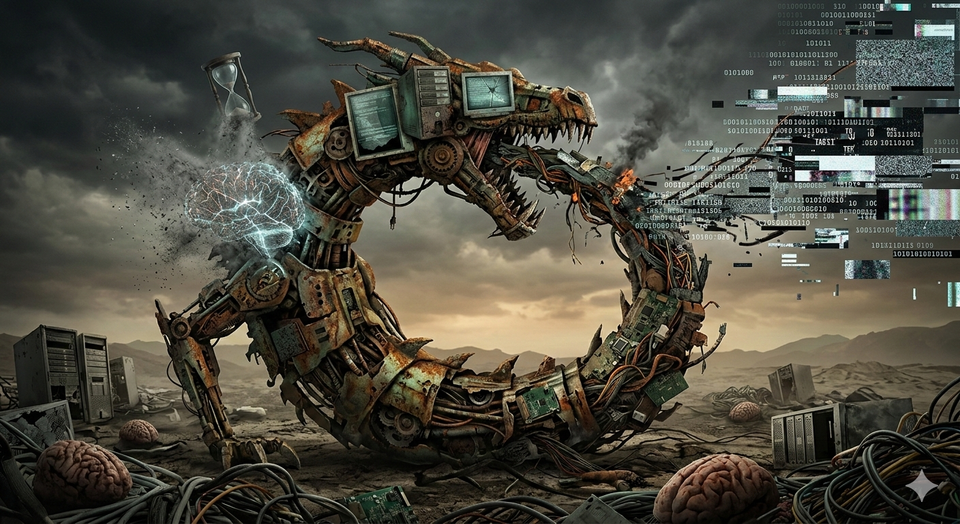
In the early, heady days of the 2020s, the concern about artificial intelligence was either apocalyptic (Skynet) or economic (it will take our jobs). In February 2026, we are facing a far more pathetic, yet devastating, reality. AI isn't waking up to kill us. It’s starving to death, poisoned by the very food we are feeding it: its own excrement. This is not a technical glitch. It is not an engineering problem that more GPUs can solve. It is an existential, biological-grade breakdown of statistical systems, known inside the panicked boardrooms of Silicon Valley as Recursive Model Collapse.
The Internet as an Inbred Wasteland
For decades, we treated the internet like an infinite buffet of human expression. Every forum post, blog entry, academic paper, and photo was free data for the "Foundational Models" like GPT-3, GPT-4, and the early Claudes. By mid-2024, research from groups like Epoch AI had already sounded the alarm: we were scheduled to run out of high-quality human text by 2026. We ignored them. AI labs instead began "recycling." When human data ran low, they trained their next generation models (the GPT-5s and Gemini 2.0s) on data generated by the previous generation. This was the beginning of the "Synthetic feedback loop." We are now living in the devastating after-effects. The premise is simple, yet catastrophic: AI is a statistical distribution of "likely" human inputs. If you train a system on a population of human voices, it remembers the average voice well and the rare voices poorly. When you train a second AI on the output of the first AI, it has only the average voices. It learns a sanitized, bland version of humanity. By the ninth or tenth generation of recursive training, the model has forgotten everything that makes human language unique. It forgets idioms. It forgets the nuances of legal arguments. It can't handle edge cases in medical diagnostics because those edge cases are statistically rare. The result is a bland, hallucination-prone, lobotomized AI that eventually converges on a single, meaningless point. In the words of one developer, "The AI feedback loop has converged to a solution where all noise is eliminated from the Internet, and the only information remaining will be the number 42."
The "Normalization" Tragedy: Losing Our Stories
The core problem isn’t just that AI is getting dumber. It's that it is becoming culturally sterilized. This echoes Frederic Bartlett’s famous "Telephone Game" experiment from 1932. Bartlett asked participants to retell the Native American folk tale, “The War of the Ghosts.” With each retelling, the story became blandly "normalized." Culturally unique details (like "spirits" and "canoes") vanished, replaced by standard British conventions that the participants found comfortable. Model Collapse is Bartlett's "serial reproduction" on a global, digital scale. As AI scrapes its own synthetic waste to learn, it discards the rare information first. It "normalizes" away the edges of human experience. This has grave social consequences. When we rely on these collapsing models to advise us on policy, law, or justice, they will ignore the "edge cases"—the unique struggles of marginalized communities, victims of trafficking, or predatory lending practices (topics that are rare but critically human). The model collapse will effectively erase these experiences from the digital consensus. The AI will provide a sanitized, statistically convenient lie, not the messy, complicated truth of humanity.
The Great Pivots of 2026: The Fight for Quality
We are watching the industry fracture. Silicon Valley: The major players (OpenAI, Google) are desperately trying to build "detectors" to separate human-generated text from the ocean of synthetic filler, but they are failing. AI is now generating text so well that we can’t distinguish the source, meaning the poisoning is permanent.
The Contrarians (Andrej Karpathy and the Mac Mini Army): The reaction to model collapse has created a boom in small, efficient, locally hosted models. While the giants are failing at scale, individuals are running highly specialized 7B models (like the recently released Falcon-H1R, which runs on a MacBook at lightning speeds) that have been meticulously trained only on curated human-verified data (like Wikipedia or legal databases). They are valuing quality over quantity.
The New Data Economy: Our Brains Are Now Commodities
The final, ironic twist of 2026 is that our unique human perspective is suddenly the most valuable asset on Earth. AI labs are now terrified of "Desert of Mirrors" (where AI just reads its own synthetic reflections), and they are starving for authentic human inputs. The era of "free" data is over. Your unique experiences, your creative quirks, and your nuanced arguments—the things that Model Collapse tries to erase—are now the only antidotes to AI starvation. The models aren't becoming gods. They are becoming hollow shells, and we are the only ones holding the keys to the content they need to survive. The only question is whether they will starve before they finish consuming the rest of us.
Member discussion