I’m a Human Being. A Woman. A Tech Founder. A Journalist. A Mother. A Torture Survivor. And Still a Human Being.
The Murder Notice
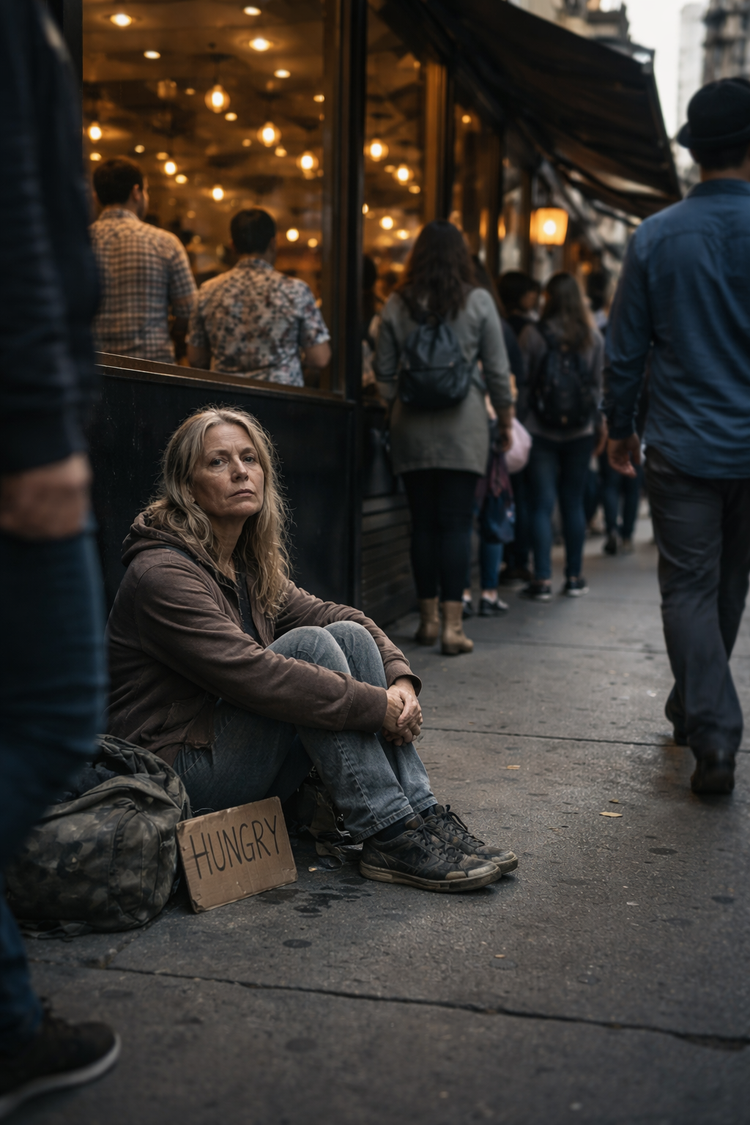
There was another notice on my tent this morning. Berkeley Parks Association, taped there like it was nothing. Paid for by my tax dollars. A piece of paper telling me to move along, with nowhere to go.
It’s not a notice—it’s a murder notice. That’s what it is.
America is a woman-murdering machine, as I have irrefutably proven with all my content, articles, plays, TikToks, and YouTubes.
A machine that enslaves, tortures, and kills women in plain sight, then pretends it’s about “policy” or “sanitation” or “order.” But what it’s really about is erasure.
I lay in my sleeping bag after I read it and felt the weight sink in. Another day of being treated like a problem to be removed, not a human being. That’s what depressed me. That’s what drags me down every morning—the knowledge that my life, my survival, my voice—none of it counts in this country.
Scattered Memory – Jay Ward
Jay Ward was once one of my closest friends. A really extraordinary guy in his own right. A tech lawyer, a connector, someone who helped launch First Friday in Oakland.
Jay was also the most interested man I ever met. He asked questions, always—who are you, what are you about? That curiosity wasn’t a performance; it was who he was. When it came time to start my tech startup, he gave me advice for free.
We also shared small things—cooking, theater. He loved sports, and one day I told him this story: how I had taped a show called The Best Damn Plays Ever because I thought it was about theater. I sat there waiting for curtain calls, but it was all football plays. Sports, sports, sports.
Jay laughed until he nearly cried. Literally fell out of the chair laughing at me (which reminded me of my dad).
Then he explained it to me, gently, with patience: “Jodi, sports are mythic battle.” The teams, the strategy, the clash. Mythic battle, modern edition. And I thought—okay, I can almost understand.
But later, after I had returned to the Bay Area and was starving, when I asked Jay for help—real help, when I was desperate—he denied me. Just like everyone else. Jay is no longer my friend, and yet I still hold that contradiction: that he was the most interested man I ever met, and that in the moment when it mattered most, he refused to see me.
Scattered Memory – Leah and the Boys
Talking about sports—one day my daughter Leah asked my son and his friends the third-rail question: Why is that all boys ever talk about?
It was Isaac’s birthday, freshman year of high school. Fourteen, maybe fifteen boys, crowded around the table eating the pizzas I had made. And the whole time: sports, sports, sports.
Leah—just eighteen months younger than Isaac—was passing in and out of the deck where they were eating. She wasn’t part of the party, but she was listening. At one point she stopped in the doorway and just cut through it all:
“Don’t you have anything else to talk about? I mean, that’s all you’re talking about—sports. Who cares? Don’t you have anything else?”
The boys froze. Then they laughed at her. No one answered.
Later, Isaac told her privately: “I think we just bond that way because it’s easy.”
But in that moment, Leah stopped the room. One girl against a sea of boys, asking the same question women have asked men for centuries.
Scattered Memory – Motherhood
I was a devoted mother. I made huge personal sacrifices. I didn’t have a full-time career during those years. I gave all my time and attention to raising my kids.
I knew you don’t really get anything back from parenting except this: happy, healthy, good citizens. But I loved it. Raising kids was a good challenge for me. And I adored my kids.
Teachers, religious leaders, other parents—I got compliments all the time. Mothers especially go out of their way to let other mothers know when they see well-parented children: We see you. We see the work you’ve done, because nobody else will say it out loud.
The compliments always came back to the same thing: kindness. My kids were the ones who would go up to an adult at pickup and say, Hey, Mrs. So-and-so, how are you? Thoughtful. Polite. Funny.
So yes, I felt good about the job I was doing. I loved my kids. And they showed the world who I was as a mother. Also, I enjoyed their company—they were the best people I knew.
Scattered Memory – What My Kids Told Me
Leah once told me: “Mom, I always feel like I can come to you. You’ll be reasonable, you’ll listen, you’ll respect me. A lot of my friends don’t feel like that with their parents. But I do.”
Isaac once told me, “If I have issues, I talk to you. I don’t need a counselor. I have you.”
Another time, in a conflict at school, he turned to me mid-discussion and said: “This is all your fault, Mom. You taught me to be empathic. And now I’m fucking empathic. I can’t just ignore people’s pain.”
And I thought: Yes. Score.
Scattered Memory – The Hitting Game
When Isaac was two or three, he hit me constantly. I hated it. I hated him for it. And I thought: This cannot continue. I cannot hate my own son. I have to teach him: you don’t hit women.
I panicked. I even read We Need to Talk About Kevin and thought: Oh God. Kevin is Isaac. Isaac is Kevin.
Finally, I found a method: reflect the natural consequences. So one day when he hit me, I said: “You want to play the hitting game? I hate that game. But okay.” And I smacked him back.
He was furious. He hit harder. I hit back harder. Back and forth. Until he stopped. And the hitting stopped for good.
It was awful. It was effective. It was survival.
Scattered Memory – Leah
Leah was the opposite. Sensitive, tender. One time I snapped at her while I was working and she burst into tears, crumpled on the floor.
With Isaac, the challenge was always boundaries. With Leah, the challenge was the opposite: how do I bring her out? How do I give her courage, confidence, voice?
I remember once, after a trip to Disneyland, Leah—about eight years old—was walking with me through the airport. Out of nowhere she started describing how beautiful her eyes were, maybe the most beautiful eyes ever, and why. And of course, I agreed completely. Years later she teased me about it: “Mom, why did you let me go on and on about how beautiful my eyes are?” And the obvious answer was: because I totally agreed.
With Leah it became my mission: nurture her voice, nurture her critical thinking, nurture her leadership.
Scattered Memory – Social Justice Training
Critical thinking meant: don’t indoctrinate. Let them find their own ideas.
And yet, of course, I shaped their world. I chose the books we read, the stories we told.
Years later, Leah caught me out on it. One day in the kitchen she said: “Mom, you were training us in social justice, weren’t you? All those kids’ books you read to us—they were Bernie Sanders stories. They were all social justice.”
Guilty as charged.
Scattered Memory – The Painful Lesson
One time I drove Leah and her teammates to a soccer game in Oakland. We got lost. The girls were nervous, and one of them made a racially charged comment. Nobody said anything. Leah stayed silent. I stayed silent.
Years later, Leah remembered it as one of her painful memories. She said: Why didn’t you say something? Why didn’t I?
The truth is, it was painful for me too. I wanted her to learn, to feel what silence does. And she did. It hurt. But some memories should hurt.
Scattered Memory – Abandonment
Then came the kidnapping. I missed out on so much of their lives. But what hurts most is that they abandoned me.
Leah, distant on her birthday call. Her father telling me not to call again.
Isaac, grown, with a job. I called him once from Mexico. Desperate. Asked him for $50 to survive. He refused. Later I saw him donate more to a friend’s birthday charity.
That night I slept in the rain. The next night, a man tried to rape me. The next night, he beat me. I almost died of exposure.
Isaac left me to die. I survived anyway.
Years later, starving in a homeless shelter, I saw his Instagram. He was traveling in Europe, eating beautiful food. I wrote to him: How can you do this? How can you leave me starving while you travel through Europe?
He blocked me.
So no, I didn’t raise them right. Or maybe I did, and the world stole them from me. Either way: they left me.
Scattered Memory – The Mothers
I’ve spoken to so many mothers who did everything right. Mothers who loved, taught, sacrificed, disciplined. Mothers who raised their boys to be good men.
And still, the boys turned cruel. The boys betrayed them.
This is not just about me. This is about patriarchy. The air our sons breathe. The script whispered in their ears: your mother doesn’t matter. Women don’t matter.
Scattered Memory – The Psychologist in Mexico
In Mexico, I met an eighty-year-old psychologist from New York. Brilliant, radiant, wonderful. She wore teeny tiny bikinis and rocked them. She longed for a partner, but couldn’t find one.
Her son—my age—was a vile misogynist. Controlled her money. Dated only twenty-year-old girls.
One night, she told him she was sad she couldn’t find a man. And he said: “That’s because you’re crazy, Mom. You’re really fucking crazy.”
I turned to her and said: “That’s why. IT IS NOT YOU. Not because of you. Because of men like him. You’re not crazy. They are the problem. They hate us.”
I was right.
But she never spoke to me again. Maybe it was too painful to face that her own son hated her.
And maybe that’s why so many women stay silent. Because it’s unbearable to admit the truth: often our sons—through no fault of our own—don’t care if we die.
Closing – I’m a Human Being
So many fragments of my life. Jay and his mythic battles. Leah at the birthday table. Isaac learning empathy too well. The compliments from other mothers. The books. The silences. The abandonment. The betrayal. The psychologist in Mexico whose son called her crazy.
The patterns are everywhere. Women sacrifice. Women nurture. Women give. And the machine still finds ways to break us, to turn even our children against us, to leave us starving, to silence us with shame.
But here’s the truth: I am still here.
I did not die when they left me in the rain.
I did not die when men tried to rape me, beat me, kill me.
I did not die when my own children abandoned me.
I am still alive.
And I am a human being.
I am a human being.
I am a human being.
Even if you refuse to see it, even if my children refuse to see it, even if the entire machine works every day to erase me—
I will say it, write it, breathe it, until your walls crack and your ears bleed.
I am a human being.
✊ The Mantra of Survival
Every day I wake up in America, I have to say words no woman should ever have to say:
“I won’t die today.”
Why?
- Because I live in a tent, and any predator could get at me.
- Because I am the enemy of the most horrific enemy humanity has ever known — the patriarchy.
- Because hospitals refuse stabilization.
- Because courts and police protect abusers.
- Because $20 million stolen from me is shielded by law.
- Because women and children are being slaughtered and tortured in silence while the government, authorities, and the press look away.
“I won’t die today” should not need to be spoken in this country. And yet—here I am, forced to say it.
So hear me clearly: 👉 Every day I say it and live it is proof I am still here, still fighting, still leading.
Repeat it with me:
“I won’t die today.”
Make it your mantra. Make it our war cry. Because we aren’t done. And we sure as hell aren’t silent.
💬 Don’t just read and scroll. That’s how they keep us quiet.
Leave me a comment—even a word, even an emoji. Let me know you hear me.
📌 connect-the-dots.carrd.co
📌 paymemymoneypos.carrd.co
🧵 Follow: @billionairetent
💌 Subscribe + share: Men Try To Kill Me on Substack
And today, hurting, as I relive these enormous, unjust losses and betrayals.
💬 Don’t just read and scroll. That’s how they keep us quiet.
Break the silence. Leave me a comment — even a word, even an emoji. Let me know you hear me.



Member discussion