
Iraq Then, Iran Now: Lessons on Intervention, Stability, and Strategic Clarity
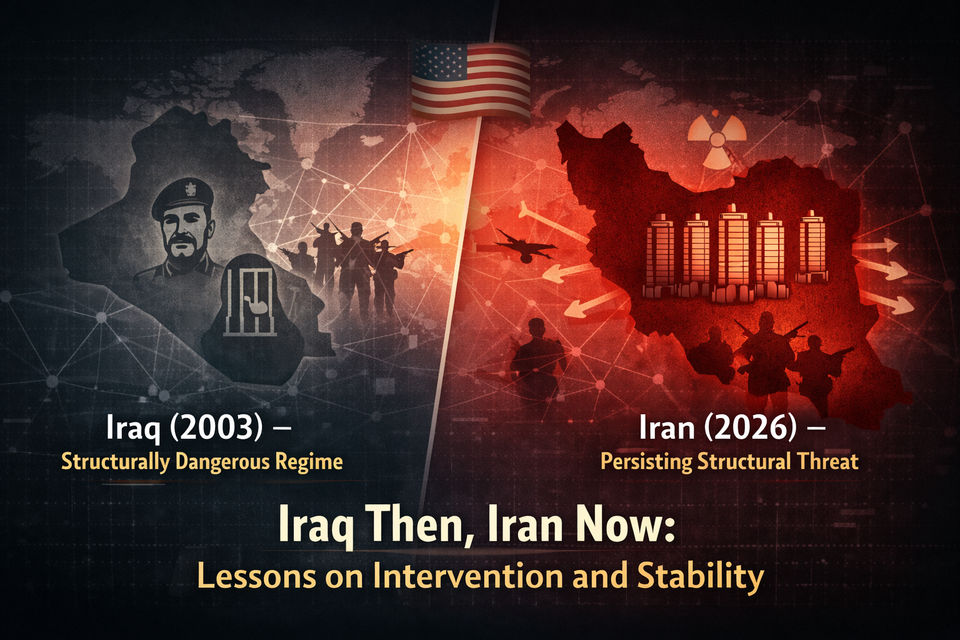
Debates about U.S. foreign policy often collapse into slogans: “another Iraq,” “forever war,” or “regime change.” Such shorthand obscures more than it clarifies. To think seriously about countries like Iran, we need to understand Iraq’s historical trajectory, the structural rationale for intervention, and the outcomes of decisive action.
The Historical Context
In 2003, the United States invaded Iraq. Conventional wisdom frames this as a response to weapons of mass destruction. From my perspective, that misses the broader point.
I believe the decision was less about intelligence reports and more about longstanding strategic failure and unfinished business. George H.W. Bush had left Saddam Hussein in power after the Gulf War. Many, including his son, viewed that as a mistake. Saddam survived, rebuilt his forces, and retained the capacity for aggression — a chronic strategic threat left unresolved.
In that context, the 2003 invasion was about correcting a long-term security problem, not simply reacting to intelligence claims.
Iraq Today: Stability and Normalization
Fast forward to 2026. Iraq is, in many ways, a functioning country. It is no longer a destabilizing force. It does not export terrorism globally. Its internal politics are complex, yes, but the hyper-authoritarian, violent, patriarchal system that Saddam once embodied is gone.
From this lens, the war’s outcome — though costly — achieved a critical objective: the removal of a structurally dangerous regime. Iraq no longer operates as a global menace. It is rebuilding, navigating internal challenges, and existing as a sovereign state — not a breeding ground for systematic aggression.
This is often overlooked by critics focused on casualties, partisan politics, or immediate post-war chaos. The world does not hear about Iraq because it is no longer a threat — and that silence is a sign of success.
Lessons for Iran
Iraq and Iran share one critical feature: both are entrenched authoritarian systems. But their trajectories diverge dramatically.
Iraq’s system was removed; Iran’s persists.
Iraq’s domestic coercion has been dismantled; Iran’s remains, thriving under patriarchal authoritarianism.
Iraq no longer projects systemic aggression abroad; Iran continues to fund proxies and export instability.
If Saddam’s regime had survived, the region would likely be far less stable today. Iraq’s relative quiet demonstrates the potential payoff of decisive intervention against structurally dangerous regimes.
This is not a blanket argument for war. It is an argument for strategic clarity: identify regimes that structurally produce threats, understand the risks of leaving them intact, and act accordingly.
Misconceptions vs. Reality
Many critiques of the Iraq War rely on persistent misconceptions:
“We destabilized the region.” Partially true immediately after the invasion, but the long-term outcome is relative stability and sovereignty.
“It created more terrorism.” Not on the scale that Iran exports today. Iraq is not a networked aggressor.
“It was about oil or hubris.” While motives are debated, the structural rationale — removing a tyrant who could threaten global security — remains valid.
These critiques often ignore the quiet, long-term benefits: regimes removed, regional threats diminished, and global focus able to shift elsewhere.
Domestic Governance and Patriarchy
Iraq’s removal of Saddam eliminated one of the most repressive patriarchal systems in the region. Saddam’s regime relied on fear, hyper-masculine authority, and systemic violence to maintain control. Once that system was dismantled, Iraq was able to rebuild — imperfectly, yes, but without a centralized structure devoted to internal terror and regional aggression.
Iran provides a stark contrast. Its patriarchal, authoritarian structure persists, producing aggression abroad, repression at home, and structural instability across the region. From an educational perspective, it is patriarchy without deterrence: male clerical authority dominates politics, security, and society; women’s autonomy is restricted; dissent is violently suppressed; and the system exports instability because it cannot tolerate internal freedom.
The lesson is structural: regimes that operate through coercion, rather than consent, generate persistent threats. Iraq shows that removing such structures can produce long-term stability.
Policy Beyond Personality
Discussions about U.S. intervention often devolve into debates about presidential motives. While intent matters politically, strategic evaluation should focus on outcomes.
Actions that reduce nuclear proliferation risk, constrain proxy violence, and reinforce regional stability can be evaluated on those merits, independent of partisan considerations. Foreign policy requires assessing capability, intent, and structural incentives — not simply reacting to personalities.
Personal Perspective
I wasn’t a huge fan of George W. Bush’s domestic politics. I didn’t like many of his decisions, and I remain critical of his overall record.
But the Iraq War? That was the right decision for America, strategically speaking. Removing Saddam Hussein’s structurally dangerous regime reduced a major threat, and history has borne that out. Iraq today is quieter, more stable, and no longer exports terror networks the way Iran does. The country is functioning as a sovereign state — imperfectly, yes — but no longer as a regional menace.
Supporting a decision does not mean endorsing everything about the person making it. It means assessing policy on its merits, independent of personality or partisanship. In this case, the policy outcome validates the decision.
Conclusion
Iraq demonstrates a principle often lost in public debate: decisive action against structurally dangerous regimes can produce lasting stability.
Saddam Hussein was removed.
Iraq is no longer a regional aggressor.
Patriarchal, authoritarian systems were dismantled.
The country now operates as a sovereign state, largely peaceful relative to its past.
Compare that to Iran: the regime persists, aggressive, and structurally dangerous. The contrast highlights why structural assessment, not media narratives or personality politics, must guide foreign policy analysis.
History, in this case, supports the argument that intervention — when focused on dismantling structurally dangerous regimes — can produce long-term stability and security. Iraq shows what strategic clarity looks like in practice, and the lesson is clear for Iran and other structurally aggressive states: unchecked power produces persistent risk; decisive action can reduce it.
Member discussion