
Jesus Is a D***: Performance Is Not Love
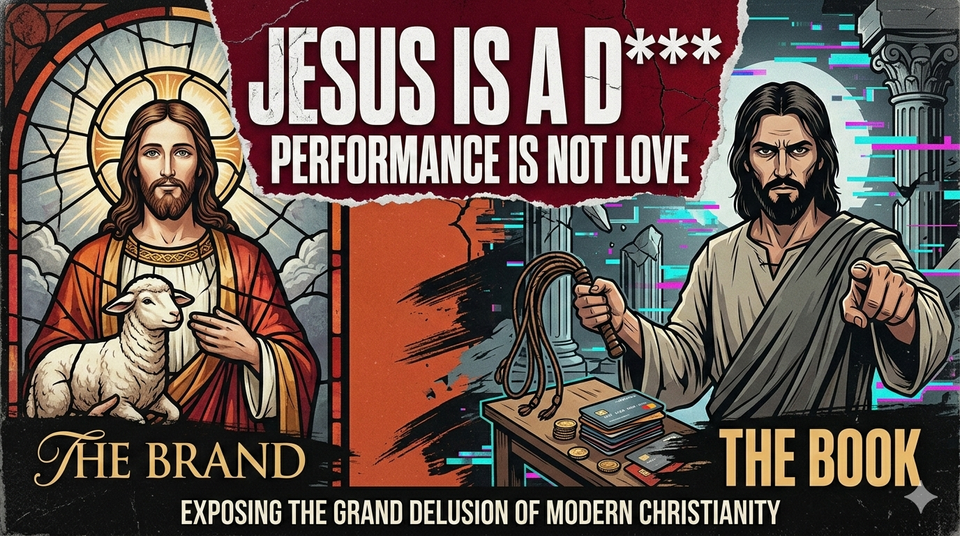
Read the Gospels as literature. Not as doctrine. Not as stained glass. As narrative. And the dominant energy in that narrative is not softness. It’s intensity.
The setting makes sense of it. First-century Judea is occupied by Rome. Taxation, humiliation, collaboration by religious elites. The air is political. Charged. Angry. Of course he’s angry. He calls leaders vipers. He condemns cities. He overturns tables in the temple. He speaks in apocalyptic ultimatums. He divides the world into sheep and goats, saved and damned.
The anger fits the moment. What’s harder to find is sustained, embodied love. We’re told he is love. That love is the center. That he defines it. But what do we actually see?
The Pattern: Rebuke as a First Response
The disciples are terrified in a storm. The boat is taking on water. These are fishermen—if they’re panicking, it’s real. He’s asleep. They wake him because they think they are going to die. His first response?
“Why are you afraid? Have you still no faith?”
Not: “You’re safe.” Not: “Of course you’re scared.” He goes straight to deficiency. Then he stills the storm. Rebuke, then miracle. It’s a classic power move—the "God-complex" version of gaslighting.
- Peter sinks in the water: “You of little faith.”
- The disciples misunderstand: “Are you still without understanding?”
- Peter objects to his death: “Get behind me, Satan.”
Vulnerability appears, and he answers with sharpness. Then comes the power. The miracle gets preached; the rebuke lingers.
The Mother: Coldness at Cana
At Cana, his mother tells him the wine has run out. He answers: “Woman, what does this have to do with me?” It’s formal. Distant. Abrupt. Then he performs his first public miracle. Again—no warmth, just power. Throughout the narrative, there is almost no recorded tenderness toward her. No visible intimacy. If this is the model of perfect love, the emotional tone is surprisingly cold.
The Fig Tree: The "Tech-Bro" Tantrum
He’s hungry. The tree has no fruit. The text notes it isn’t even the season for figs. He curses it. It withers. It’s hard not to see the throughline: non-performance meets a death sentence. Like a loser tech-bro founder whose API fails for five seconds, he nukes the whole system in a fit of pique.
Performance Is Not Love
The narrative is full of spectacle. Water into wine. Walking on water. Feeding thousands. Raising the dead. It reads like a demonstration. Power enacted publicly. But performance is not the same thing as love.
- Love steadies. * Love absorbs fear. * Love regulates the temperature in the room. The figure on the page raises the temperature. He is compelling, electrifying, and severe. He doesn’t read like a calm father figure holding frightened people steady. He reads like a man on fire. Mature love transforms anger; it doesn’t radiate it in every direction.
The Grand Delusion: The Brand vs. The Book
What is truly amazing is the delusional nature of modern Christians. I’m not sure who they’re thinking of, but it’s not the guy in their book. They have a version of their God that isn’t reflected in the actual text. They make it up as they go along, fueled by whatever the pastor describes.
They’ve replaced the volatile, high-demand autocrat with a "Gentle Shepherd" who doesn't exist on the page. This is where double-think is born. To remain a believer, you have to hold two contradictory ideas:
- The text says he is an apocalyptic judge who demands total compliance and rebukes his own family.
- The "vibe" says he’s a soft-hearted best friend.
To survive that contradiction, they simply stop reading. They ignore the "d***" factor and worship a hallucination.
The Verdict
The "Jesus" of modern Christianity is a curated fantasy. They claim to follow the Book, but if they actually read it—without the filter of a sermon—they’d realize their "God" is a narcissistic performer they’d avoid at a party. He’s not a savior; he’s a spectacle. And the faith required to believe otherwise isn't a virtue—it’s a clinical detachment from reality.
Member discussion