Marketers Are Getting Duped Into Saying Nothing, Everywhere

The content marketing category is a $400 billion industry.
And it’s estimated that by 2024, the content marketing industry will grow by another $270 billion, bringing the grand total to nearly $700 billion.
But “content marketing” is broad, and includes everything from creation to distribution to content management. For example, in 2020 the enterprise content management industry was valued at $47 billion, and is projected to more than double over the next five years to more than $105 billion. Translation: of the soon-to-be $700 billion content marketing industry, 20% of the entire market is exclusively dedicated to “managing” the content that gets created.
Well, what’s the content?
More importantly, how much of the content being created (especially by enterprise companies and B2C companies) is actually worth reading?
When was the last time you clicked on a company blog post, opened a company newsletter, or listened to a corporate podcast and said to yourself, “Wow, I sure am glad I clicked on that!” The fact that most content marketing is garbagé (as they say in French) represents one of the greatest marketing opportunities of our time—for those willing to buck current conventional wisdom.
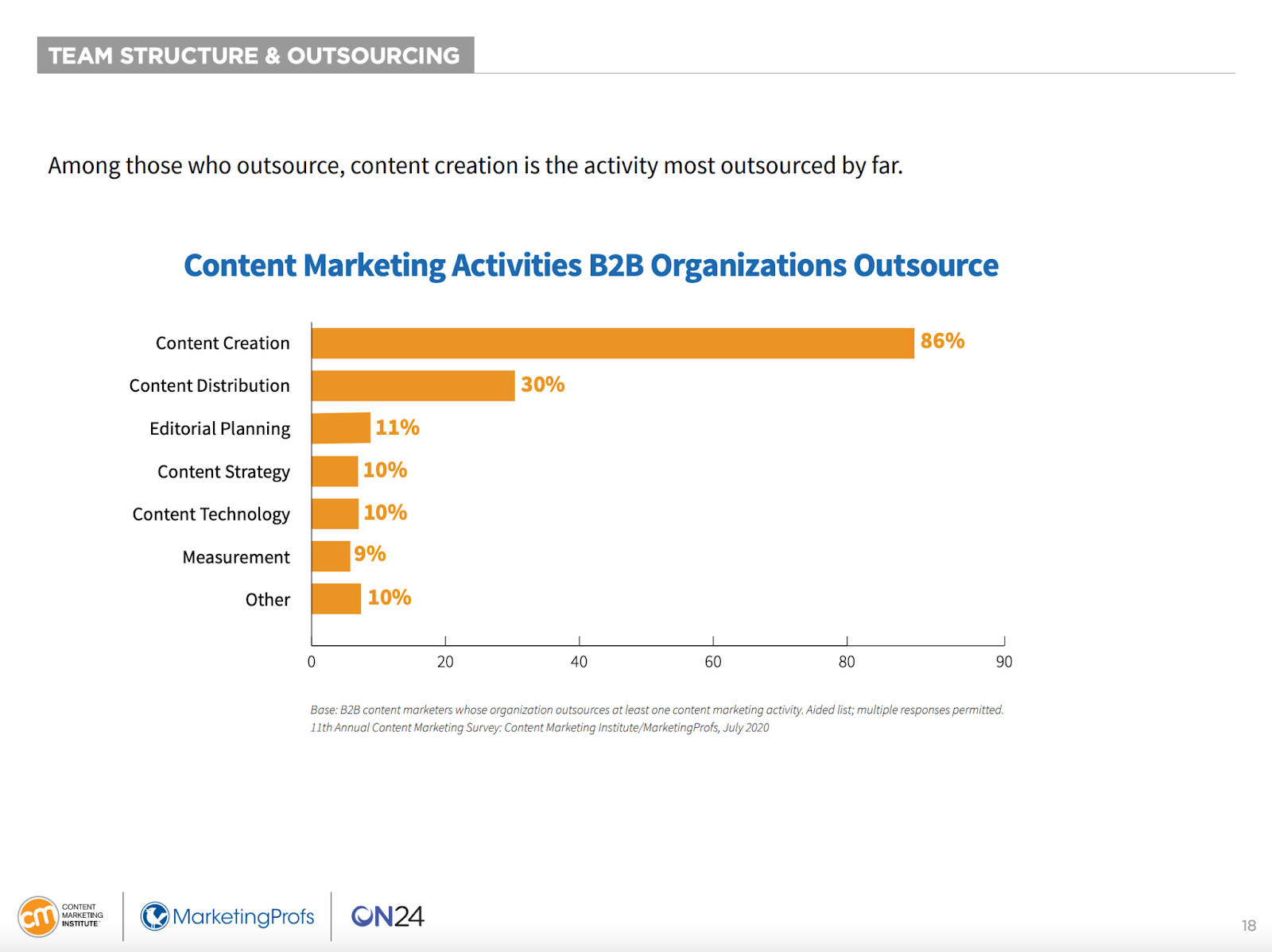
The “content management” subcategory of the mega content marketing category is growing faster than ever—and yet, according to Content Hacker, the #1 activity B2B companies outsource is content creation (by a mile). 86% of B2B organizations surveyed said they outsourced content creation. The next-closest activity is content distribution, which only 30% of B2B organizations surveyed said they did. Editorial planning, 11%. Content strategy, 10%. Content technology, 10%. And so on.
Now let’s connect these two data points.
- On the one hand, “content management” is growing at breakneck speed. Content creation creates more to manage.
- On the other hand, “content creation” is often the number one most outsourced marketing activity. Which means companies are deferring the single most important aspect of “content,” which is the creation of each and every idea.
Many marketers today have (unfortunately) caught Gary Vee-D, a “content disease” that leads creators and companies alike to believe the whole purpose of content creation is to “do it”—and to do it as often as possible.
Document everything, right? It doesn’t matter if it’s good. It doesn’t matter if it’s valuable. Just say it loud and say it often.
“Pump out 200 pieces of content a day!” Gary Vee and other digital marketing shysters have led the masses to believe the fact you “did it” means you are succeeding. More equals mo’ better. You are winning. And so marketers everywhere have adopted this Spray & Pray approach—where 100% of the emphasis is on the output, and essentially 0% (OK, that might be a slight exaggeration, but you get the point) of the emphasis is on the quality of the content and what’s actually being said.
As a result, creators and enterprises deploy “more content, more often” strategies.
Again: of the soon-to-be $700 billion content marketing industry, 20% of the entire market is exclusively dedicated to “managing” the content that gets created. The other 80% gets outsourced to agencies, contractors, analysts, and “gurus” whose “big idea” is to get you to post quote graphics from yourself (or your company) on LinkedIn 12x per day with things like, “Hustle is the secret to success,” “Digital transformation success stories,” and “Win small, to win big.”
This is what I like to call content-free marketing.
Content-Free Marketing: The Art Of Saying Nothing, Everywhere
Reach & Frequency strategies are not successful. Reach & Frequency means “the more people (reach) who see my brand, more often (frequency), the better off we’ll be.” No, these advertising legends were successful because they owned a specific position in the customer’s mind (a category)—and you did not achieve this leadership position via Reach & Frequency (aka: “brand as many customers with our logo as possible”).


Member discussion